


 BACK HOME
Dark Money
“Dark Money” is spending meant to influence political outcomes where the source of the money is not disclosed; usually via nonprofit organizations who are not required to disclose their donors. www.investopedia.com
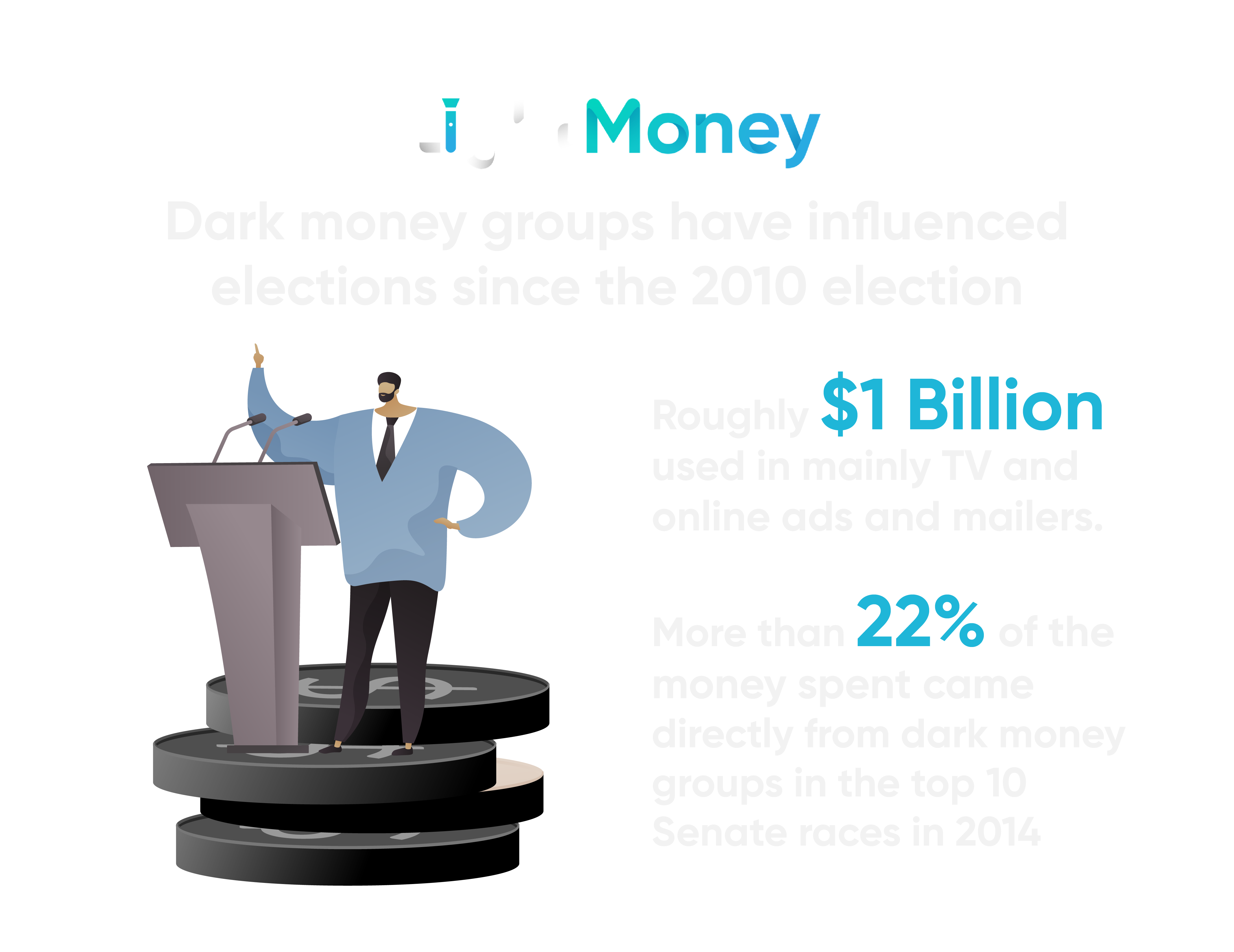
Dark Money is on the rise with over $300M spent on the 2012 presidential election vs. $5.9M in 2004.
It is reported Dark Money spending in the first year of the 2016 presidential election cycle was 10x more than it was at that point in 2012.
Dark Money isn’t a partisan issue as dark money supports all parties. There are many politically active nonprofits in existence who can accept unlimited donations from corporations, unions and individuals, while not having to make this information public. Fred Wertheimer, the founder and president of Democracy 21, for one, has said that “history makes clear that unlimited contributions and secret money are a formula for corruption.”

We give an "A" grade to ratings with a score of 80-100, a "B" grade to ratings with a score of 60-80, and so on. Ratings are roughly normally distributed around a mean of 50.
Causes form the basis of impact ratings and analysis on Ethos ESG. Ethos currently has 45 causes available, based on the United Nations Sustainable Development Goals (SDGs). See descriptions of all causes, SDGs, metrics, and explore in more detail at www.ethosesg.com/definitions.
Light Money focuses on what we think are of the most common areas of concern for the public today based on what investors are telling us is important. These 6 causes are also personally near and dear to the team at Wayfinder Wealth Management.
The 3 metrics shown in the above 6 scorecards were selected by pulling Ethos data for each cause, sorting by weighting, and selecting the highest weighted metrics that had a measurable result while trying to minimize overlap and subjective scoring. These metrics are also aligned with the most common shareholder resolutions that are filed . For a full list of all causes, metrics, screens, and more, please visit www.ethosesg.com/definitions.